Dr. Othman Charles Sadeq Al Hamouz
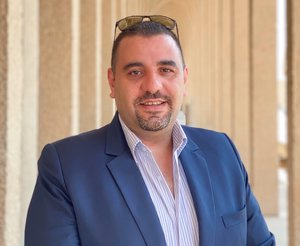
Associate Professor
My research focuses on designing, synthesizing, and applying advanced polymeric materials, where controlled architecture and functionality enable high-performance solutions for carbon capture, gas treatment, environmental remediation, and energy-related separation technologies.
📍 Bldg. 4-261-1
☎ (+966) 13 860 7345
🔗 ORCID: 0000-0003-1885-6934
🔗 Scopus: 15043639000
Research Area
⬡ Porous organic polymers for CO2 capture, gas storage, and separation
⬡ Polymer-based adsorbents for water treatment and environmental remediation
⬡ Polymer nanocomposites with carbon nanotubes and functional nanoparticles
⬡ Cross-linked and functionalized polymer networks for improved performance
⬡ Application-driven polymer chemistry for environmental and energy systems
My research program focuses on designing, synthesizing, and applying advanced polymeric materials with specific chemical structures and functionalities. The main idea is simple: polymer architecture influences performance. By adjusting porosity, functionality, crosslink density, and hybrid interfaces, I have created materials that address key challenges in carbon management, natural gas treatment, environmental cleanup, and energy-related separation processes.
Research Focus 1: Porous Organic Polymers for Carbon Capture, Gas Treatment, and Storage
A primary focus of my research is on creating porous organic polymers and cross-linked networks for selective adsorption and separation. This includes CO₂ capture under real-world conditions and the removal of acid gases like CO₂ and H₂S from natural gas. The approach combines rational monomer design, functional-group engineering, and structure–property analysis to improve adsorption capacity, selectivity, and stability. Recent work features heteroaromatic and triptycene-based porous copolymers, functionalized systems targeting CO₂ capture, and new materials for iodine and methyl iodide sequestration. The research trajectory has shifted from solely adsorption to integrated capture and conversion strategies, increasing the scientific and industrial significance of the work.
Research Focus 2: Functional Polymers for Environmental Cleanup and Metal Recovery
The second major area involves designing polymer-based adsorbents for environmental remediation, especially for selectively removing toxic metal ions from water and complex samples. My group develops nitrogen-rich cross-linked polymers and functional networks—including hyper-crosslinked polyamines and imidazole/thiol-functionalized systems—to enhance uptake performance and selectivity. This research supports environmental sustainability and aligns with strategic goals, such as metal recovery. Recent work includes materials for mercury removal from wastewater and specialized polymer systems for recovering silver ions from seawater and electronic waste. This reflects a shift from mere removal to selective capture and recovery, which is increasingly vital for circular economy efforts. This theme is reinforced through projects focused on the rapid recovery of precious metals and innovative remediation materials.
Research Focus 3: Polymer Hybrid Systems and Composites for Harsh and Industrial Conditions
The third area emphasizes polymer-based hybrid systems and composites designed for demanding industrial environments. It involves integrating polymers with nanomaterials, such as carbon nanotubes, functional nanoparticles, and hybrid porous frameworks, to enhance mechanical strength, transport, and adsorption capabilities. My work includes polymer/CNT composites and mixed-matrix membranes aimed at gas separation and performance improvements via interfacial engineering. Additionally, the group developed polymers suited for high-temperature and high-pressure environments, including oil-well cementing applications, where additives must withstand severe conditions while enhancing rheology and performance. This area is highly relevant to industry and supported by external projects with Saudi Aramco on natural gas dehydration, mercury removal from hydrocarbons, acid-gas separation, and high-temperature cement materials.
Overall, my work advances the development of sophisticated polymeric materials, linking fundamental structure–property insights to impactful environmental and energy application
Education
✔︎ PhD: King Fahd University of Petroleum and Minerals, Dharan, Saudi Arabia, 2013
Title: “Synthesis and Applications of Linear and Cross-linked pH- Responsive Polycarbo-, Polyphospho- and PolySulfobetaines”
✔︎ MSc: University of Jordan, Amman, Jordan, 2004
Title: ”Synthesis and characterization of polycarbonates based on bisalkyl (aryl) carbonates”
✔︎ BSc: Jordan University of Science and Technology, Irbid, Jordan, 2019
- Al Hamouz, O. C. S. Synthesis of Diaminobipyridine-Triptycene Porous Copolymers for Gas Treatment. Journal of Applied Polymer Science 2026, 143 (9), e70158. DOI: https://doi.org/10.1002/app.70158.
- Amasha, H.; Ahmad, A.; Al Hamouz, O. C. S. Effect of structure and functionality on the performance of triptycene-heteroaromatic porous polymers for selective CO2 capture. Microporous and Mesoporous Materials 2026, 401, 113944. DOI: https://doi.org/10.1016/j.micromeso.2025.113944.
- Kulal, N.; Al-Abdullah, T.; Mekki, A.; Ahmad, A.; Al Hamouz, O. C. S. New Polymeric Materials for Gaseous Iodine and Methyl Iodide Sequestration. Journal of Applied Polymer Science 2026, 143 (5), e58155. DOI: https://doi.org/10.1002/app.58155.
- Al-Hamouz, O. C. S. Spirobifluorene copolymers incorporating phenanthroline and phenothiazine for selective CO2 adsorption and hydrogen uptake. Sustainable Chemistry and Pharmacy 2025, 46, 102086. DOI: https://doi.org/10.1016/j.scp.2025.102086.
- Ahmad, A.; Ahmed, A.; Elkatatny, S.; Dugaither, A. A.; Heinold, T.; Zahrani, B. H.; Abahussain, A. A.; Al Hamouz, O. C. S. A study of a new polymeric retarder for enhanced rheology and its effects on properties of oil well cement. Construction and Building Materials 2025, 472, 140913. DOI: https://doi.org/10.1016/j.conbuildmat.2025.140913.
- Falca, G.; Fallatah, E. S.; Abdulazeez, I.; Al Hamouz, O. C. S. Effective mercury removal by a new imidazole-functionalized polyamide for wastewater treatment: experimental and theoretical studies. New Journal of Chemistry 2025, 49 (18), 7630-7641, 10.1039/D5NJ00300H. DOI: 10.1039/D5NJ00300H.
- Al-Qahtani, R. A.; Abdelnaby, M. M.; Abdulazeez, I.; Al-Hamouz, O. C. S. Synthesis and optimization of 3D porous polymers for efficient CO2 capture and H2 storage. Carbon Capture Science & Technology 2024, 13, 100330. DOI: https://doi.org/10.1016/j.ccst.2024.100330.
- Amasha, H.; Ahmad, A.; Abdulazeez, I.; Al Hamouz, O. C. S. Microwave-synthesized heteroaromatic porous organic polymers for CO2 capture and hydrogen storage. Materials Today Sustainability 2024, 27, 100879. DOI: https://doi.org/10.1016/j.mtsust.2024.100879.
- Al Ghamdi, K.; Ahmad, A.; Falca, G.; Alrefaeia, M.N.; Al-Hamouz, O.C.S. Efficient Removal of Mercury from Wastewater Solutions by a Nitrogen-Doped Hyper-Crosslinked Polyamine. Polymers 2024, 16, 2495. https://doi.org/10.3390/polym16172495
- Alloush, A. M.; Abdulghani, H.; Amasha, H. A.; Saleh, T. A.; Al Hamouz, O. C. S. Microwave-assisted synthesis of novel porous organic polymers for effective selective capture of CO2. Journal of Industrial and Engineering Chemistry 2022, 113, 215-225. DOI: https://doi.org/10.1016/j.jiec.2022.05.049
Dr. Aqeel Ahmad
Postdoctoral Fellow
Issam Malkawi
PhD Student
Mohammed Nizar
MS Student
Mohammed Mohsin H Alshebber
MS Student
| Undergraduate Courses Taught |
|---|
|
• CHEM 101 General Chemistry • CHEM 201 Organic Chemistry I • CHEM 451 Polymer Chemistry |
| Graduate Courses Taught |
|---|
|
• CHEM 630 Phys. Chemistry and Characterization of polymers • CHEM 530 Polymers in Oil & Gas Industries • CHEM 537 Polymer Synthesis |